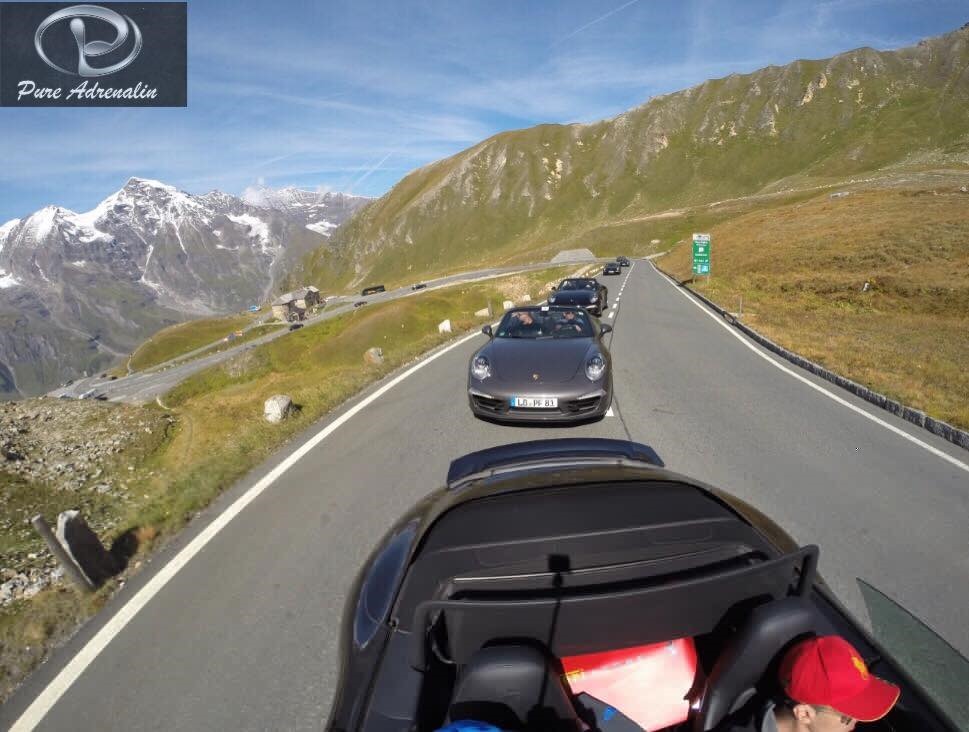
Picture the moment this feature actually earns its place: eight cars strung out along a switchback climb, the lead car three hairpins ahead and out of sight, the last car in the group fallen back to let a slower driver find their rhythm, and precisely zero of that visible to anyone through a windshield. This is the exact situation DRV.club’s live convoy map was built for.
What’s actually on the screen
Every car in a posted drive shows up as a live dot on a shared map, visible to every other member of that same drive — not an abstraction of “the group is somewhere ahead,” but the actual, current position of the lead car, the last car, and everyone in between, updating continuously as the road bends and the group naturally spreads out. On a straight coastal road this is a nice-to-have. On a mountain pass with switchbacks stacked every few hundred meters, it’s the difference between a guide who has to guess how far back the slowest car has fallen and a guide who can see it precisely and adjust the pace without anyone radioing in to ask.
Why the walkie-talkie channel matters more than it sounds like it should
Traditional two-way radios need line of sight, or close to it — exactly what a mountain pass with rock walls and blind corners refuses to provide. DRV.club’s walkie-talkie channel runs over mobile data instead, which means it tolerates the patchy, intermittent signal typical of an alpine pass far better than line-of-sight radio ever could — a message doesn’t need a clean unbroken path between two cars, just enough of a data connection somewhere along the chain to get through. It’s not flawless in a genuine dead zone with zero signal at all, but it degrades far more gracefully than the alternative, and on a route like the Grossglockner passes on the Porsche Europe tour, that gap in reliability is exactly where a traditional setup would leave a guide flying blind.
What it actually changes for the guide
A guide running a group of exotic cars through a demanding road has always had to solve the same problem: keep the group close enough to feel like a convoy without bunching cars up dangerously through blind corners, and never let anyone fall back far enough to actually get lost or left behind. Before a tool like this, that problem got solved by experience, gut feeling, and a lot of checking mirrors at rest stops. With the live map, it gets solved with actual information — a guide can see a car falling behind in real time and radio ahead to ease the pace, rather than discovering the gap only when the group reassembles at the next scenic stop and someone’s missing.
Turning on automatically, not manually
The system activates 30 minutes before a posted drive’s scheduled start, for every member who RSVP’d — nobody has to remember to open an app feature or press start once the cars are already moving. That timing matters more than it sounds like it should: the last thing anyone wants at a 6 a.m. departure is a guest fumbling with settings while the rest of the group waits.
This is one piece of a larger system — read the full introduction to DRV.club for the digital garage, the driver community, and the referral program that come with it. Get the app.