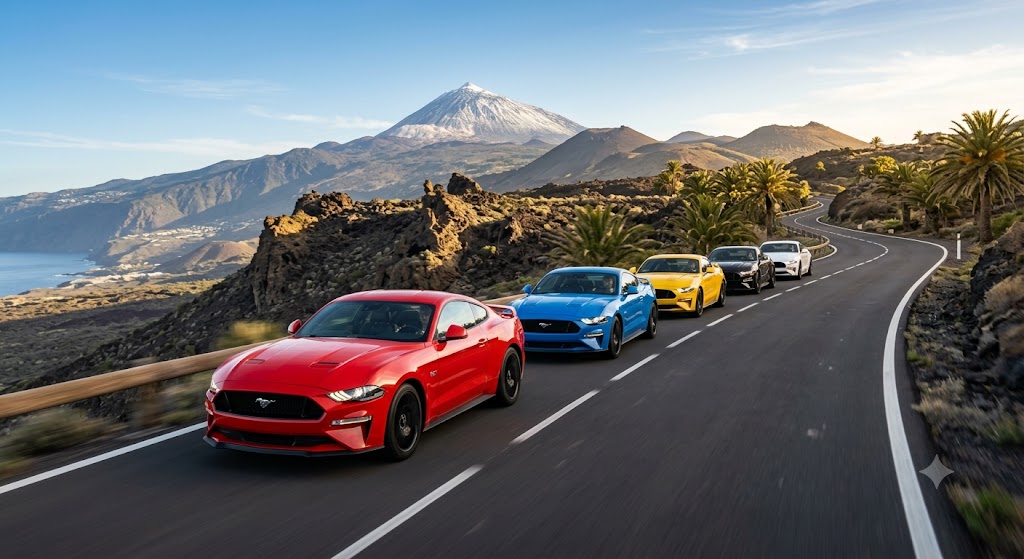
Ask someone to picture Tenerife and they’ll describe a beach, a volcano, maybe a resort pool. Almost nobody pictures a forest so dense and permanently damp that moss grows on the north side of every tree trunk. That’s exactly what day 6 delivers, and it’s precisely why it tends to surprise people more than any other day on the route.
A forest that shouldn’t still exist
The Anaga massif, at Tenerife’s northeastern tip, holds one of the last significant surviving stands of laurisilva — laurel forest — on Earth. This forest type once covered large parts of southern Europe and North Africa during a warmer, wetter climatic period millions of years ago; as the Mediterranean basin dried out, it vanished almost everywhere except a handful of Atlantic island microclimates that kept the old conditions alive. The Canary Islands are one of the last strongholds, and Anaga is one of the best-preserved examples within them — UNESCO recognized the massif as a Biosphere Reserve specifically for this reason.
Why it stays this green
The trade winds that keep the rest of southern Tenerife dry and sunny do something completely different when they hit the Anaga peaks: they get pushed upward, cool rapidly, and condense into a near-permanent low cloud layer that sits over the ridgeline for much of the year. The result is a forest that receives moisture constantly, whether or not it’s actually raining — a phenomenon locally called “horizontal rain,” where the trees themselves comb moisture directly out of passing cloud. It’s a genuinely different climate from anywhere else on the island, sitting less than an hour’s drive from the beach resorts of the south.
Driving the TF-12
The road itself, the TF-12, threads through the forest in a continuous series of serpentine curves — tighter and more enclosed than the open volcanic plains of Teide, with a canopy overhead in places that turns the road into something closer to a green tunnel than an open mountain drive. Visibility changes constantly as cloud drifts through the ridgeline, and the road surface stays damp more often than not, which changes the character of the drive noticeably from the dry, grippy tarmac of the earlier days. It rewards a measured pace rather than outright speed — partly for grip, partly because there’s genuinely more to look at here than on almost any other stretch of the route.
The viewpoint that ends the day
The drive concludes at a viewpoint looking down over Las Teresitas, a golden-sand beach on Tenerife’s northern coast, imported sand and all — a striking contrast after a morning spent entirely inside dense, damp forest canopy. It’s the kind of view that only really lands after the drive that precedes it: the same island that just spent two hours convincing you it was somewhere in the Pacific Northwest suddenly hands you a Caribbean-looking beach from a single overlook.
Why this is the last driving day, not an earlier one
Placing Anaga on day 6, right before the trip transitions to its rest day, is deliberate: it’s a genuinely different kind of driving experience from the technical intensity of Masca or the scale of Teide, more meditative than either, and it works as a natural wind-down after five days of increasingly demanding roads. Guests who’ve done the whole route consistently describe day 6 as the one that recalibrated their sense of what the island actually is — less “one more spectacular road” and more “an entirely different place that happens to share a coastline with everywhere else we’ve been this week.”
Anaga is day 6 of Pure Adrenalin’s Tenerife Grand Tour — the final driving stage before the rest day. See the full route.